
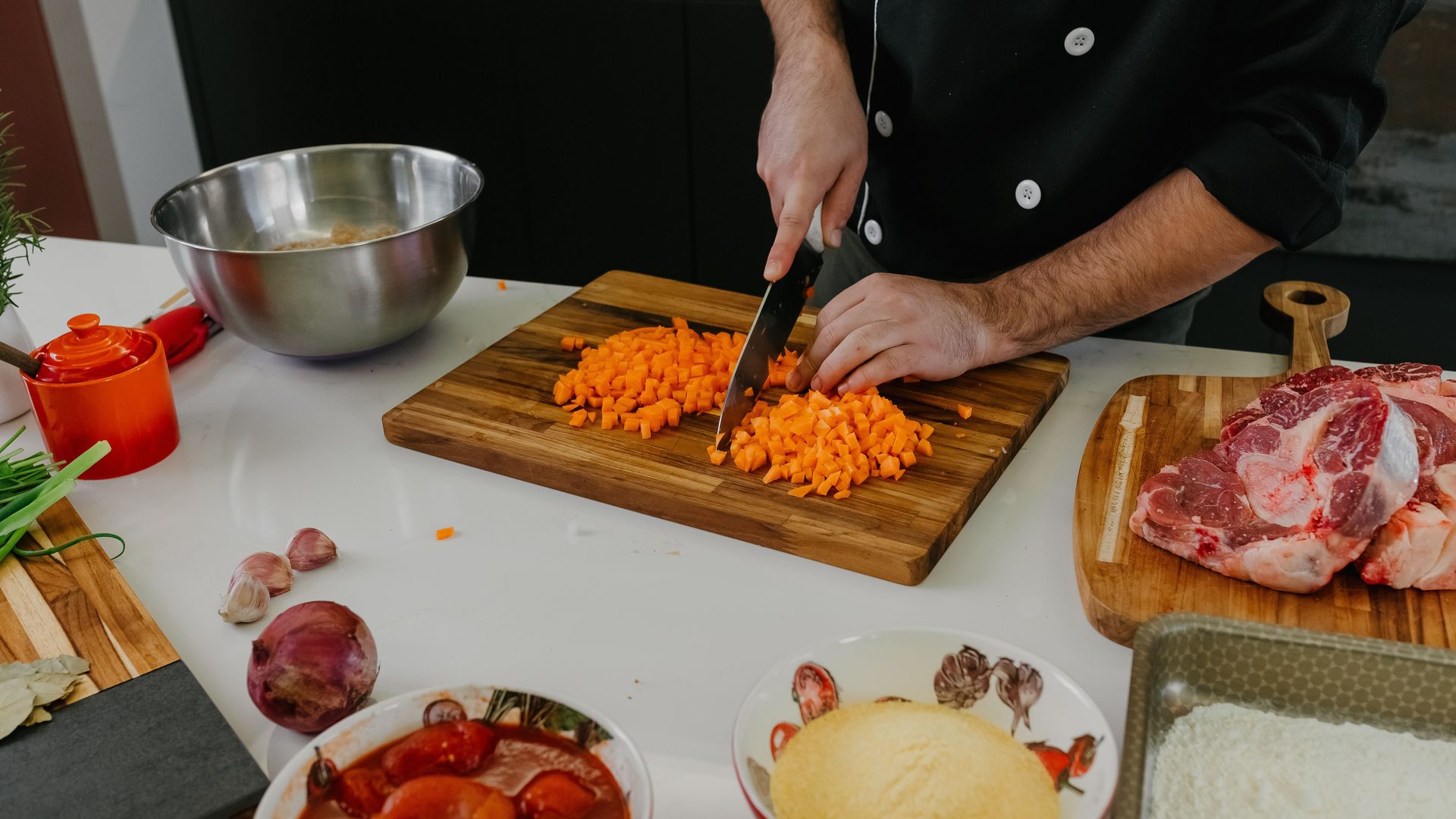
Photo by Jonathan Borba on Pexels
Mise en place (said "meez-ahn-plahs") is French for "everything in its place." In a restaurant kitchen it means every ingredient prepped, every tool set out and every station stocked before the first ticket prints, so that during service the cook only has to cook.
Every cook learns the phrase in their first week. Most kitchens still treat mise en place as a personal virtue: the good cooks have it and the others don't. That is why one station is immaculate on Tuesday and a mess on Saturday, and why the line only runs well on the nights the right people are working.
This article treats it as something bigger than one cook's cutting board. It is a system for the whole line, with a written standard, a par, an owner and a check, and it is what decides how service goes long before the first order comes in.
What Mise en Place Means in a Restaurant
At home, mise means chopping your onions before you turn on the burner. On a line it covers a lot more than the food. When a chef asks whether your mise is ready, they are asking about four things at once.
| Layer | What it covers | What it looks like when it's missing |
|---|---|---|
| Ingredients | Every component for every dish on the station, prepped, portioned where it should be, and in the right quantity for the night. | A cook dicing shallots with six tickets hanging. |
| Tools and equipment | Pans, tongs, spoons, squeeze bottles, ladles, towels, sanitizer, a thermometer, plates or bowls for the station. | Someone yelling for a clean sauté pan or walking to dish for a spoon. |
| The station | Everything in a fixed position, arranged in the order it gets used, with backups staged somewhere the cook can reach. | The garnish lives on the left one night and the right the next, and every plate slows down while the cook looks for it. |
| The plan | The cook knows the menu, the specials, what is low, and what the reservation book says is coming. | Surprised by a twelve-top at 7:15 that has been on the book all week. |
The fourth layer gets skipped the most. A station can be fully stocked and still fall apart if the cook did not know the special changed or that the private party ordered off the regular menu. Mise is a physical setup and a mental one.
Why It Decides How Service Goes
Nobody wins a Saturday at 8pm. By then the outcome was mostly set at 3pm, when the station either got built properly or didn't. During the rush the cook's job is to repeat the same movements quickly and correctly. Anything that interrupts that repetition, like a missing pan, an item not yet cut or a walk to the walk-in, costs time on the ticket in front of them and on every ticket behind it.
It shows up in three places an owner actually cares about:
- Ticket times. A cook who never leaves the station keeps times steady through the push. One who has to leave it three times an hour is adding minutes you will hear about from the floor.
- Consistency. When portions are ready in the right amount and in the right container, the plate at 9pm matches the plate at 5pm. When the cook is portioning on the fly, it drifts, and it usually drifts heavy.
- Waste. Mise prepped to a par gets used. Mise prepped to a feeling ends up in the trash or in a sad family meal. Our guide to reducing restaurant food waste covers why overproduction is one of the biggest line items.
Why It Breaks Down: It Lives in One Cook's Head
Walk the line in most kitchens and you can tell who is on the grill just by looking at the station. That is the problem. When mise depends on who is working, it is a habit belonging to a few people rather than a standard belonging to the kitchen.
It usually breaks down in the same few ways. The standard was never written down, so each cook sets the station up the way they learned somewhere else. The par was never set, so the amount of prep is whatever the opener guessed. Nobody checks the station before service, so problems show up at the worst possible moment. And the closer never resets it, so the opener spends the first hour of the morning undoing the night before.
None of that is a character problem. It is what happens to any standard that only exists in someone's memory. Your best cook takes the system home with them every night, and on their day off it isn't there.
A system
- Written setup sheet with a photo per station
- Par for every item, by day of week
- Same position for every pan, every day
- A check before the first ticket
- Station reset at close, by a named person
A habit
- "Set it up like Marco does"
- Prep amounts based on a guess
- Layout changes with whoever is on
- Problems found when the ticket prints
- Whoever is left does whatever is left
Every station set up the same way, whoever is on.
The whole operation in one place, built around the way your restaurant already works. Money stops leaking, your time stops disappearing into follow-up, and every shift leaves a record with a name on it.
The Station Setup Sheet
The single most useful document for mise is a one-page setup sheet for each station. It turns "set it up right" into something a cook who started on Monday can do correctly on Friday. Each sheet lists every item on the station, the container it lives in, where it goes, how much to have for service, and where the backup is.
Here is what a simple one looks like for a grill station:
| Item | Container | Position | Par for service | Backup |
|---|---|---|---|---|
| Portioned steaks | Sheet tray, covered | Lowboy, top shelf left | 18 | Walk-in, shelf 2 |
| Chicken thighs, marinated | 1/3 pan | Lowboy, top shelf right | 24 | Walk-in, shelf 2 |
| Compound butter | 1/9 pan | Rail, slot 1 | 1 full | Lowboy door |
| Chimichurri | Squeeze bottle | Rail, slot 2 | 2 bottles | Lowboy door |
| Pickled shallots | 1/9 pan | Rail, slot 3 | 1 full | Walk-in, shelf 4 |
| Finishing salt, pepper | Salt pigs | Shelf above rail | Full | Dry storage |
| Tongs, spatula, towels | Hotel pan | Right of grill | 2 each, 6 towels | Dish rack |
Three details make the sheet work. First, add a photo of the finished station taken from where the cook stands. A picture settles arguments that a list can't. Second, arrange the rail in the order of use, so the cook's hands move one direction as a plate builds. Third, tie every item to a recipe, so "chimichurri" means the same thing no matter who made it. A standardized recipe sheet template is where that lives.
Station placement matters here too. Mise can only be as good as the station it sits on, and if the lowboy is on the wrong side or the plates are ten steps away, no setup sheet fixes that. Our guide to restaurant kitchen layout covers designing stations so cooks stop walking.
Building Mise Backwards From the Covers
Mise on the station is the end of a chain that starts with a number: how many people you expect to feed. Work backwards from it and the prep list almost writes itself.
- Forecast covers. Use the same day last week and last year, then adjust for reservations, weather, events and anything unusual on the books.
- Set pars by station and day. How many portions of each item that station typically uses on a night like this, plus a small buffer. A Tuesday par and a Saturday par should not be the same number.
- Count what's already on hand. What's left from yesterday, and whether it is still usable at your standard.
- Prep the difference. Par minus on hand is what gets prepped today. Nothing more.
- Assign it with a deadline. Each item has a person and a time it needs to be done by, working back from when the station has to be set.
That last step is where most prep lists quietly fail. A list without names is a suggestion. A list with names and times is a plan, and it tells you at 2pm, not at 5pm, that the sauce station is behind.
Pars are the same idea you use for ordering, just one step closer to the plate. If your kitchen already sets pars for ordering, our guide to restaurant inventory management covers how to set and review them.
The free mise en place checklist
Tick it off on screen or save it as a PDF and print one per station. It works best alongside a setup sheet for each station, so the checklist says "set up" and the sheet says exactly what that means.
Before prep starts
Station setup
Before the first ticket
During service
Close and reset
Holding It Through the Rush
A perfect station at 5pm is only half the job. Mise decays during service, and the cooks who stay out of the weeds are the ones who maintain it while they cook rather than after they fall behind.
- Restock in the lulls. Every service has gaps between pushes. That is when the 1/9 pans get refilled, not when one is already empty.
- Call it early. "I'm getting low on chicken" at half a pan is a quick fix. At zero it's an 86 or a cook leaving the station mid-push.
- Clean as you go. A cluttered board and a pile of dirty pans slow every plate after them. Wipe, swap the towel, send pans to dish.
- Nothing gets set down "for a second." The empty container that lands on the rail stays there until close and takes a slot you need.
This is also where the expediter and the sous earn their pay. Someone off the line should be watching stations for what's running low and sending help before the cook has to ask.
Tomorrow's Mise Starts at Close Tonight
The close is the most underrated part of mise en place. A station broken down properly, with everything kept covered, labeled and dated, gives the opener a clean start and an honest count. A station left for the morning costs the opener an hour and gives them a guess.
The close is also where the pars get better. Whatever ran out tonight means the par was too low. Whatever is sitting in the lowboy untouched means it was too high. A closing cook who writes down both on a shift report is handing the next day's prep list its most useful information. Skip that note and the kitchen makes the same mistake on the same night next week.
Labeling and holding practices are something to confirm with your local health department so your standard matches what applies where you operate. Then write that standard into the setup sheet so it is the same on every station. Our guide to kitchen organization covers the label format and the walk-in shelf map that make the close quick.
How to Train It and Check It
You can't teach mise en place by describing it. New cooks learn it by setting up the station next to someone who has it right, and then having it checked against the standard until they get it right without help.
- Show, then shadow. Hand them the setup sheet and the photo. Have them build the station next to a strong cook for their first few shifts.
- Check before service, every day. A chef or lead walks each station against its sheet before the first ticket. It takes a few minutes and catches problems while there's still time to fix them.
- Make it part of the job, on paper. Station setup belongs in the role itself. Our line cook job description puts it right in the duties so it is expected from day one.
- Write it into your procedures. The setup sheets, pars and closing routine are standard operating procedures. Our guide to restaurant SOPs covers writing them so the next person can actually follow them.
If you are building a broader training program around this, our guide to restaurant staff training covers the structure, and the complete guide to restaurant operations shows where the kitchen standard fits into the rest of the building. For a look at the role itself, the Bureau of Labor Statistics keeps an occupational profile for cooks that covers the work and the outlook.
If your line only runs clean on the nights your best cooks are working, the standard is in their heads instead of the kitchen. Crewli is a fully custom operations app built around how your restaurant already runs, so setup sheets, prep lists and station checks have an owner and a time and leave a record behind. Let's talk.
Frequently Asked Questions
What does mise en place mean?
Mise en place is a French phrase meaning "everything in its place." In a restaurant kitchen it means having every ingredient prepped, every tool set out and every station stocked before service starts, so that during the rush a cook only has to cook. It covers more than chopped vegetables: the pans, towels, backups, plates and the cook's own plan for the night are all part of it.
How do you pronounce mise en place?
It is pronounced roughly "meez-ahn-plahs." In most kitchens you will hear it shortened to "mise" (said "meez"), as in "is your mise ready?" or "restock your mise before the second push." Nobody on a line says the full phrase during service, so if a new cook hears "mise," that is what it means.
What is the difference between prep and mise en place?
Prep is the work: cutting, portioning, cooking sauces and components ahead of time. Mise en place is the finished state that prep produces, arranged at a station and ready to use. A kitchen can finish all of its prep and still have poor mise if the prepped food sits in the walk-in, the containers are in the wrong place, or the cook has no backups within reach. Prep answers what gets made; mise answers where it lives and whether the cook can reach it without moving.
How do you set up mise en place for a line station?
Start from a written station setup sheet that lists every item on the station, the container it lives in, its fixed position, and how much of it to have for service. Pull prepped items to that par, arrange them in the same position every day in the order the cook uses them, set out tools, towels, sanitizer and plates, and stage backups in a known spot. Then have a chef or lead check the station against the sheet before the first ticket.
Why is mise en place important in a restaurant?
Because service is decided before it starts. A cook who has to leave the station to find an ingredient, cut something mid-rush, or hunt for a clean pan is adding minutes to every ticket behind them. Good mise keeps ticket times steady, keeps plates consistent because portions are ready in the right amount, and cuts waste because prep is sized to the night instead of guessed. It is also the difference between a calm line and a panicked one.
How much mise en place should a station prep for a shift?
Enough to get through the expected covers with a small buffer, and no more. Set a par for each item based on how much that station typically uses on that day of the week, adjust it for reservations or events, and prep to that number. Prepping to a feeling produces either an 86 at 8pm or a pile of product at close. Track what actually ran out and what was left over, and adjust the pars every couple of weeks.
How do you teach mise en place to new cooks?
Show them the standard instead of describing it. Give them the station setup sheet with a photo of the finished station, have them set it up next to an experienced cook, then check it together against the sheet before service. Repeat until it is right without help. Most new cooks do not fail at mise because they are careless; they fail because the standard lived in somebody else's head and nobody wrote it down.