
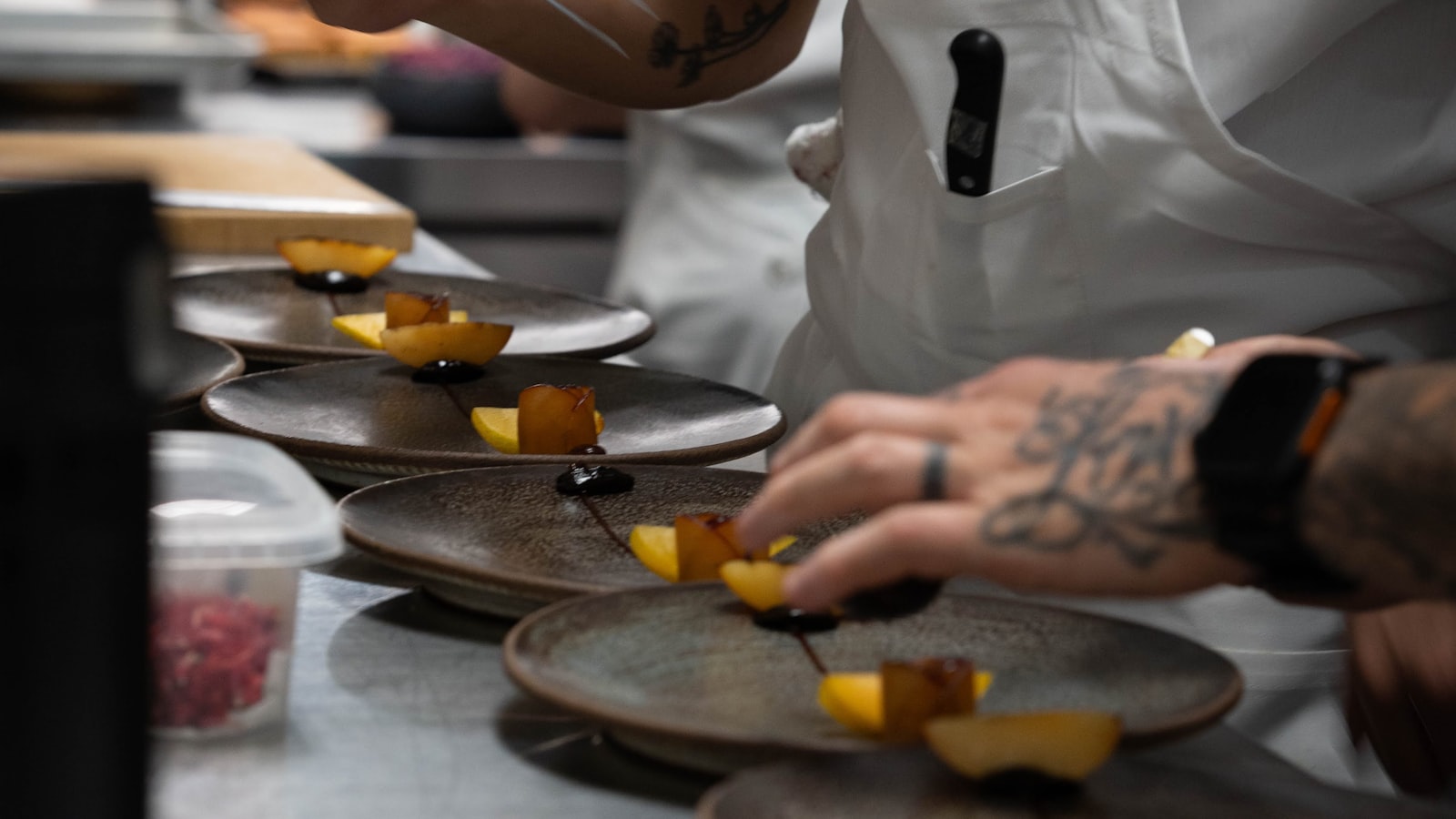
Photo by Madeline Liu on Unsplash
Most line cook job descriptions are interchangeable. Copy one, swap the restaurant name, post it, and wonder why the only applicants are people who've never held a station in their life. The generic wish list ("2+ years experience, culinary degree preferred, must work well in a fast-paced environment") filters for nobody. It reads like every other listing, so the cooks who could actually run your grill on a Saturday scroll right past it.
A good line cook job description does the opposite. It reads like the real job: the specific station, the actual duties before, during, and after service, the physical reality of the work. By being honest, it filters out the mismatches before you waste an interview on them. It's the first tool in your hiring process, and it sets the expectation the rest of the operation has to keep.
This guide breaks down what a line cook actually does, the duties and skills that belong on the description, how to write one that filters right, a free template you can copy or save as a PDF, and, the part most articles skip, how to turn that job description into the job as it's actually run.
What a Line Cook Actually Does
A line cook owns a station on the kitchen line (grill, sauté, fry, garde manger, pantry) and is responsible for everything that comes off it during service. That's the whole job in one sentence, but the weight is in one word: consistency. A line cook's real product isn't a great plate on a slow Tuesday. It's the same plate, to spec, on the four-hundredth cover of a Saturday rush, in the heat, at speed, without slipping.
The role is often confused with a prep cook. A prep cook works mostly before service, doing the chopping, portioning, and batch cooking that stocks the line, usually at a steadier pace, and it's a common path onto the line. A line cook works during service, cooking to tickets in real time in front of guests, where mistakes cost covers immediately. Your description should be clear about which one you're hiring, because the temperament each requires is different.
Before you can describe the role, you have to know which station you're filling and what "good" looks like on it. That clarity is the foundation of the whole restaurant hiring process. A vague sense of "we need a cook" produces a vague job post, which produces vague applicants.
Line Cook Duties and Responsibilities
The cleanest way to write line cook duties, and the way that reads like the real job, is to break them into the three phases of a shift. This is the structure that goes straight onto the description.
| Phase | Core responsibilities |
|---|---|
| Before service | Set up and stock the assigned station, complete prep to par levels, verify freshness and spec, and confirm mise en place is in place before the first ticket. |
| During service | Cook and plate to tickets, hold the timing and pace set by the expo, communicate on the line, and follow portion, plating, and food-safety standards on every dish. |
| After service | Break down and deep-clean the station, log temperatures and waste, label and store product correctly, and restock so the next shift walks into a ready line. |
Notice that food safety and cleaning aren't a separate afterthought; they run through every phase. A line cook who cooks beautifully but leaves a filthy, understocked station is only doing a third of the job. That through-line of standards is exactly what a good set of restaurant standard operating procedures is built to hold consistent from one cook to the next.
The standard is set before they ever clock in.
The whole operation in one place, built around the way your restaurant already works. Money stops leaking, your time stops disappearing into follow-up, and every shift leaves a record with a name on it.
Skills and Qualifications to Look For
The mistake most descriptions make here is listing a wall of requirements that filters out good candidates and attracts none. Separate what a cook truly must have from what's merely nice, and be honest about which is which.
| Must-have | Nice-to-have |
|---|---|
| Solid knife skills and station organization (mise en place) | Formal culinary training or a degree |
| Speed and composure under the pressure of a rush | Experience with your specific cuisine or concept |
| Food-safety knowledge and temperature discipline | Ability to work multiple stations |
| Ability to follow a recipe and plating spec exactly | Prior fine-dining or high-volume experience |
| Reliability: shows up on time, ready to work | Food-handler's certification already in hand |
| Communication on a loud, fast line | Bilingual on a mixed-language line |
The must-have column is mostly temperament and consistency, not credentials, because those are the things you can't train quickly. A reliable cook with clean fundamentals and the right attitude will outperform a credentialed one who can't hold composure at 8pm. That's also why a paid working interview tells you more than any résumé; we cover how to run one, and what to ask before it, in our guide to restaurant interview questions.
How to Write One That Filters Right
The goal isn't to attract the most applicants. It's to attract the right ones and repel the wrong ones before they apply. A description written like the real job does that automatically. Here's the difference in practice:
Write it like this
- "Sauté station, dinner service, high-volume Italian, 150–250 covers a night."
- "Set your station to par, cook to ticket, break down and restock for AM."
- "Standing 8–10 hours, hot line, lifting up to 50 lbs."
- "$X–$X/hr depending on experience. Tue–Sat, 3pm–11pm."
- "Reply with your availability and where you've worked the line."
Not like this
- "Seeking a rockstar cook to join our family!"
- "Various kitchen duties as assigned."
- (No mention of the physical reality of the job.)
- "Competitive pay." (No number, no schedule.)
- "Serious inquiries only."
Every line on the left gives a real cook the information they need to self-select: the station, the volume, the schedule, the pay, the physical demand. The right column tells them nothing and, worse, signals a kitchen that hasn't thought the role through. A few rules that hold across every good listing:
- Name the station and the volume. "Line cook" is vague; "grill station, 200-cover dinner service" is a real job a cook can picture.
- Put a real pay range in. Missing or "competitive" pay is the single fastest way to get skipped. For a defensible range, check current numbers for Cooks from the Bureau of Labor Statistics and price to your market.
- Be honest about the hard parts. The heat, the hours, the standing, the pace. Honesty filters out the wrong people and earns trust with the right ones.
- Keep the requirements tight. List what's truly required. Every unnecessary "must-have" quietly deletes good candidates.
- Make applying easy and specific. Ask one or two questions that a real cook can answer in a sentence.
The Free Line Cook Job Description Template
Here's a complete, ready-to-use template. Copy it into your job post and swap the highlighted placeholders for your details, or hit Save as PDF to keep a clean copy for your hiring file.
Line Cook Job Description Template
Line Cook | [Restaurant Name]
Location: [City / neighborhood] • Schedule: [e.g. Tue–Sat, 3pm–11pm] • Pay: [$X–$X/hr, based on experience]
About the role
[Restaurant Name] is a [concept / cuisine, e.g. high-volume neighborhood Italian] looking for a reliable line cook to run our [station, e.g. sauté] station during [service, e.g. dinner] service, roughly [volume, e.g. 150–250] covers a night. If you take pride in a clean station and hitting the same plate every time, you'll fit here.
What you'll do
- Before service: set up and stock your station, prep to par, and check everything is fresh and to spec.
- During service: cook and plate to tickets, hold the pace with the expo, and follow our portion, plating, and food-safety standards.
- After service: break down and deep-clean your station, log temps and waste, and restock for the next shift.
What you bring
- Solid knife skills and tight mise en place
- Speed and composure during a full rush
- Food-safety knowledge and temperature discipline
- The ability to follow a recipe and plating spec exactly
- Reliability: you show up on time, ready to work
- [Food-handler's card, if required in your area]
The real conditions
This is a hot-line role: standing [8–10] hours, working in heat, and lifting up to [50] lbs. Nights and weekends are part of the schedule.
How to apply
Reply with your availability and a sentence or two on where you've worked the line. [Add application link / email.]
Customize every bracketed field to your restaurant. This is a general template, not legal advice. Confirm any required certifications and wage rules for your state and locality.
Beyond the Hire: Turning the Description Into the Job
Here's the part almost every "line cook job description" article leaves out. The description isn't the end of the work. It's a promise. You told a cook the job is "set your station to par, cook to spec, break down and restock." The day they start, that promise either becomes real or it evaporates into "follow whoever's on and figure it out."
When it evaporates, you get the pattern every operator knows: a good hire who never quite gets consistent, who does it one way on Tuesday and another on Friday, who leaves inside three months because nobody ever showed them what "right" actually looked like. That's not a bad cook. That's a job description that was never connected to the operation. And it's one of the quiet, expensive drivers of restaurant staff turnover.
Closing that gap is a systems problem, and it's the whole reason we build what we build. The duties you wrote should become the things the cook actually works from every shift:
- The "before / during / after" duties become station checklists the cook opens on their phone, so setup, temps, and closedown happen the same way every shift, no matter who's on.
- "Cook to spec" becomes a pull-up recipe and plating standard at the station, not a thing they half-remember from a rushed first day.
- "Prep to par" becomes a live prep list tied to the forecast, so the line is stocked without the 6pm scramble.
- Reliability becomes visible (who did what, when), so accountability isn't a guess and good cooks get the credit they've earned.
That's the bridge from a strong first day to a cook who stays. A clean onboarding process hands them the standard, and consistent training keeps it, but both only hold if the standard lives somewhere the cook can pull it up mid-service instead of in one veteran's head. That's exactly what our custom task management and accountability app is built to do: turn the job description into the job, on every station, every shift.
Write the honest description, hire for consistency, then give that cook a system that makes consistency the easy path. If you want help building that system for your kitchen, let's talk.
Frequently Asked Questions
What does a line cook do?
A line cook runs a station on the kitchen line during service (grill, sauté, fry, garde manger, or pantry), preparing and plating dishes to the restaurant's spec, on time and consistently. Before service they set up their station and prep to par; during service they cook to tickets and keep pace with the expo; after service they break down, clean, and restock for the next shift. The core of the job is executing the same dish the same way whether it's the first cover or the four-hundredth, in the heat and speed of a full rush.
What are the main duties of a line cook?
A line cook's duties fall into three phases. Before service: set up and stock the station, complete prep to par levels, and check that everything is fresh and to spec. During service: cook and plate to tickets, hold the pace and timing set by the expo, and follow food-safety and portion standards. After service: break down and deep-clean the station, log temperatures and waste, and restock so the next shift walks into a ready line. Underneath all of it is consistency: hitting the recipe and the plating standard every single time.
What skills does a line cook need?
The must-haves are knife skills, station organization (mise en place), speed under pressure, an understanding of food safety and temperatures, and the ability to follow a recipe and plating spec exactly. Just as important are the human skills: communication on a loud line, composure during a rush, and reliability: showing up on time, ready to work. Formal culinary training is a plus but not required; plenty of excellent line cooks learned entirely on the job. What can't be skipped is consistency and the temperament to hold it when the kitchen is slammed.
What qualifications do you need to be a line cook?
Most line cook roles require little formal qualification: often just a food-handler's card (where your state or county requires one) and prior kitchen experience, though many kitchens will train a promising cook from a prep or dish role. A culinary degree helps but is far from mandatory. What matters most on the hiring side is demonstrated reliability and the ability to hold a station under pressure, which is why a working interview (a paid trial shift) tells you more than any résumé. Write the job description to filter for those realities, not a wish list of credentials.
How much does a line cook make?
Line cook pay varies widely by region, concept, and volume. The U.S. Bureau of Labor Statistics tracks wages for Cooks, Restaurant in its annual Occupational Employment Statistics, which is the most reliable source for current, location-specific numbers. Fine dining and high-volume kitchens tend to pay above the median; quick-service and small independents tend to sit below it. When you post the role, list a real, competitive range; vague or missing pay is one of the fastest ways to get good cooks to scroll past your listing.
What is the difference between a line cook and a prep cook?
A prep cook works mostly before service, doing the chopping, portioning, and batch cooking that stocks the line, usually at a steadier pace and often as an entry point into the kitchen. A line cook works during service, cooking and plating to tickets under the speed and pressure of a live rush. The skills overlap, and prep is a common path to the line, but the line cook role demands more speed, consistency, and composure because mistakes happen in real time in front of guests. Your job description should be clear about which role you're hiring for.
What should a line cook job description include?
A strong line cook job description includes a short, honest role summary; the specific station or stations you're hiring for; the real duties broken into before, during, and after service; the must-have skills separated from the nice-to-haves; the physical realities of the job (standing for long shifts, heat, lifting); the schedule and a real pay range; and a clear path to apply. Skip the copy-paste wish list. The best descriptions read like the actual job, which filters out mismatches before you ever spend time on an interview.