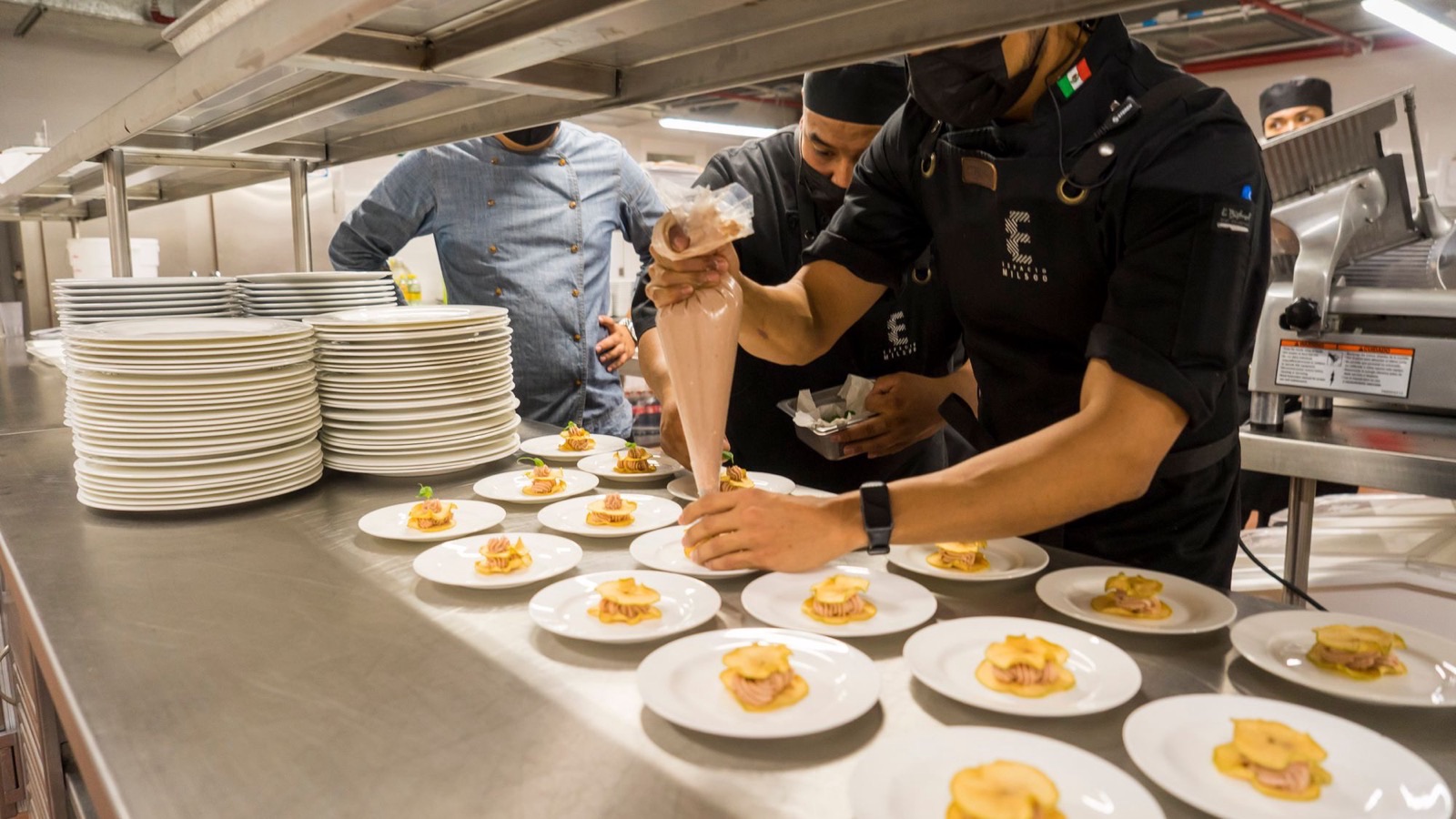
Photo by Luis Becerra Fotógrafo on Pexels
In a restaurant, 86 means you're out. When the kitchen calls "86 short rib," the short rib is gone for the night, servers stop selling it, and somebody updates the POS. That's the short answer to what does 86 mean, and it's the one you'll hear on every line in the country.
The longer answer is that 86 is one word in a whole language. Kitchens run on short, loud calls because there's no time for full sentences when twelve tickets are on the rail. New hires who don't know that language spend their first weeks a step behind, guessing at what "all day," "behind" and "on the fly" mean while everyone around them is moving.
Below is what 86 means and where it might come from, how to 86 an item without chaos on the floor, and a printable kitchen slang glossary you can hand every new hire on day one.
What Does 86 Mean?
86 gets used three ways, and the first one covers about 90% of what you'll hear.
- We're out of it. "86 the halibut." The item is sold out or unavailable for the rest of the shift. This is the everyday meaning.
- Take it off. "86 the onions on table 12." Remove an ingredient or item from an order. Some kitchens use it this way, some don't, so it's worth being clear about which one your kitchen means.
- Cut them off. "Table 9 is 86'd." A guest is cut off at the bar or asked to leave, and sometimes not welcome back. Bar staff use this one most.
The past tense is 86'd ("the brisket is 86'd"), and the opposite is that an item has come back: more was prepped, and it's available again. A good kitchen calls both out loud.
Where 86 Comes From
Nobody knows for sure, and anyone who tells you the origin with total confidence is repeating folklore. The theories you'll hear most often:
- Rhyming slang for "nix." Eighty-six rhymes with nix, as in "nix that," meaning cancel it.
- Old lunch-counter codes. Diners and soda fountains once used number codes for common calls, and 86 is said to have been the code for "we're out."
- Chumley's in New York City. A former speakeasy at 86 Bedford Street, where the story goes that patrons were told to "86 it" out the Bedford Street door when a raid was coming.
The Chumley's story is the most fun, and the least provable. For running a kitchen, the origin doesn't matter. What matters is that everybody in your building uses the word the same way.
How to 86 an Item Without Chaos
Saying 86 is easy. The damage happens in the gap between the kitchen running out and the last server finding out. Every table that orders the short rib after it's gone gets a server walking back with bad news, and every one of those moments costs you a little goodwill.
A clean 86 has four steps, and each one needs an owner:
- Call it early. The cook on the station calls it when they're down to the last few portions, not when the last one is on the plate. "Two short rib left" gives the floor time to stop selling.
- One person announces it. Usually expo or the manager on duty. It goes to every server, the bar and the host, in person or at a pre-shift huddle.
- Update the POS right away. Mark the item out so it can't be rung in. A verbal 86 that never makes it into the POS is how you end up with three more tickets for something you don't have.
- Call it back when it returns. If more gets prepped, tell the floor it's back and turn it back on in the POS. Kitchens are good at calling 86 and bad at calling it back, which quietly costs sales.
Do this
- Call it at the last few portions
- One person tells the whole floor
- Mark it out in the POS immediately
- Write it on the 86 board by the pass
- Call it back when it returns
Not that
- Wait until the last plate is gone
- Tell whichever server walks by
- Forget the POS until a ticket comes in
- Rely on everyone remembering
- Leave it 86'd after more is prepped
If you run out of the same item every Friday, that isn't an 86 problem, it's a prep problem. Track what gets 86'd and when, and use it to fix your par levels. Our guide to mise en place covers building prep around what the night actually needs.
Everyone knows what’s 86’d, not just whoever heard it first.
The whole operation in one place, built around the way your restaurant already works. Money stops leaking, your time stops disappearing into follow-up, and every shift leaves a record with a name on it.
The Printable Kitchen Slang Glossary
Here are the terms a new hire will hear in their first week, grouped by when they come up. Print it, put it in your new hire welcome packet, and tape a copy by the time clock. Every kitchen has its own house words too, so add yours to the bottom.
Kitchen Slang Glossary
The words every new hire hears in their first week. Print it, tape it by the time clock, add your own.
01Calling orders
- 86
- We're out. Stop selling it. "86 short rib."
- All day
- The total of an item across every open ticket. "Four burgers all day."
- Ordering / order in
- A new ticket just came in. Start it.
- Fire
- Start cooking it now. Often used for the next course. "Fire table 6 mains."
- Hold
- Don't start it yet, wait for the call. Also "hold the onions" means leave them off.
- On the fly
- Needed right now, ahead of everything else. Usually a mistake or a rush replacement.
- Heard
- Got it, message received. The answer to every call. "Heard, chef."
- Pick up
- A plate is ready in the window. Come and get it.
- Walking in
- On its way to the kitchen, or a guest who just arrived.
- Refire
- Cook it again from scratch. The first one was wrong, dropped or sent back.
- Ticket / chit
- The printed order. The rail is where tickets hang.
- Dupe
- The duplicate copy of a ticket, usually the one the station works from.
- SOS
- Sauce on the side.
- Come back
- An 86'd item is available again.
02Moving around the kitchen
- Behind
- I'm passing right behind you. Don't step back.
- Corner
- I'm coming around a blind corner. Slow down.
- Hot
- I'm carrying something hot. Give me room. "Behind, hot."
- Sharp / knife
- I'm carrying a blade. Watch your hands.
- Hands
- I need someone to run food. "Hands, please!"
- Coming through / backs
- Moving through a crowded space. Clear a path.
03Stations and places
- The line
- The row of cooking stations where food is made during service.
- The pass / window
- Where finished plates wait to go out to the dining room.
- Expo
- The expeditor who runs the pass, calls tickets and checks plates before they leave.
- Walk-in
- The walk-in cooler. A reach-in or lowboy is a smaller cooler at the station.
- Dish pit
- The dishwashing station.
- Garde manger
- The cold station: salads, cold apps, sometimes desserts. Also called pantry.
- Flat top / plancha
- A flat griddle cooking surface.
- Salamander
- An overhead broiler used to melt, brown or finish dishes.
- Mise / mise en place
- Everything prepped and in its place before service. "Is your mise set?"
04Service and the floor
- FOH / BOH
- Front of house (the dining room) and back of house (the kitchen).
- Two-top / four-top
- A table for two or for four. A deuce is a two-top.
- Cover
- One guest. "We did 200 covers" means 200 guests.
- Turn
- Seating a table again after the last party leaves.
- Comp
- Giving something for free, usually to fix a problem.
- Runner
- The person who carries food from the pass to the table.
- VIP / PX
- A guest who gets extra attention: a regular, an owner's friend, a critic.
- Campers
- Guests who stay long after they've paid while people wait for the table.
- Family meal
- The staff meal, usually before service.
05When it gets busy
- In the weeds
- Overwhelmed and falling behind. Say it early so someone can help.
- Slammed / crushed
- Very busy. A rush that's hitting everyone at once.
- Dying in the window
- Plates sitting at the pass too long, getting cold, waiting for a runner.
- Push
- The big rush. "The 7:30 push."
- Make it work
- Figure it out with what you have.
- Yes, chef
- Understood and on it. Used in more formal kitchens.
06Your kitchen's house words
How to Teach Kitchen Slang to New Hires
Most kitchens teach slang the hard way: the new hire hears "behind" for the first time with a sheet tray of hot pans an inch from their back. A few minutes of teaching up front saves weeks of confusion and a few close calls.
- Hand them the glossary on day one. Put it in the onboarding packet with the schedule and the station map. Our guide to the restaurant onboarding process covers what else belongs in that first day.
- Teach the safety words first. Behind, corner, hot and sharp matter more than anything else on the list. Walk through them before the new hire ever touches a station.
- Make "heard" a habit, not an option. A call that nobody answers is a call nobody can be sure landed. Insist on it from everybody, every time.
- Pair them with a trainer on a real shift. Reading the words is one thing. Hearing them at full speed on a Friday is another. A good trainer translates in the moment.
- Add your house words. Every kitchen has nicknames for dishes, stations and regulars. Write them down so they stop living in one person's head.
It all fits into a bigger restaurant training program, and our guide to restaurant staff training covers how to make the training actually stick. If you're hiring cooks right now, our line cook job description template is a good place to start.
If your 86s, prep lists and shift notes are still living on scraps of paper and in people's memory, that's the problem Crewli is built to solve. We build a custom operations app around how your restaurant already runs, so the whole team sees what's 86'd, what's prepped and what's next. Let's talk.
Frequently Asked Questions
What does 86 mean in a restaurant?
In a restaurant, 86 means an item is gone and can't be sold for the rest of the shift. If the kitchen calls "86 short rib," servers stop selling it and the POS gets updated. It can also mean taking something off an order ("86 the onions") or cutting off a guest, as in "that table is 86'd." The first meaning is by far the most common.
Where does the term 86 come from?
Nobody knows for sure. The most repeated theories are that it was rhyming slang for "nix," that it came from old lunch-counter number codes, and that it started at Chumley's, a former speakeasy at 86 Bedford Street in New York City. None of them has been proven, so treat any confident origin story as folklore. What matters in the kitchen is that everyone uses it the same way.
What does 86'd mean?
86'd is the past tense: the item has been called out and is no longer available. "The halibut is 86'd" means it's gone for the night. Applied to a person, being 86'd means being cut off or asked to leave, and it's sometimes used for a guest who is no longer welcome back. Restaurants also say an item has "come back" when more is prepped and it's available again.
What does "all day" mean in a kitchen?
"All day" is the total count of an item across every open ticket. If expo calls "four burgers all day," there are four burgers working right now, no matter how many tickets they're spread across. It lets a cook plan the whole station at once instead of reading each ticket one at a time, which is how a line stays together on a busy night.
What does "behind" mean in a kitchen?
"Behind" means "I'm passing right behind you, don't step back." It's said every time someone moves behind another person on the line, often with what they're carrying: "behind, hot" or "behind, sharp." It's one of the first words a new hire should learn on day one, because a busy kitchen is tight and people carrying pans and knives can't see over their shoulders.
What does "in the weeds" mean?
"In the weeds" means overwhelmed and falling behind, with more orders than you can keep up with. A server with too many tables or a cook with a rail full of tickets is in the weeds. The useful habit is to say it out loud early, so a manager or a teammate can jump in before tickets start dying in the window.
What does "heard" mean in a kitchen?
"Heard" means "I got it, message received." When expo or the chef calls something out, the cook it applies to answers "heard" (or "heard, chef") so the person calling knows it landed. It sounds like a small thing, but a kitchen where calls go unanswered is a kitchen where orders get missed.