
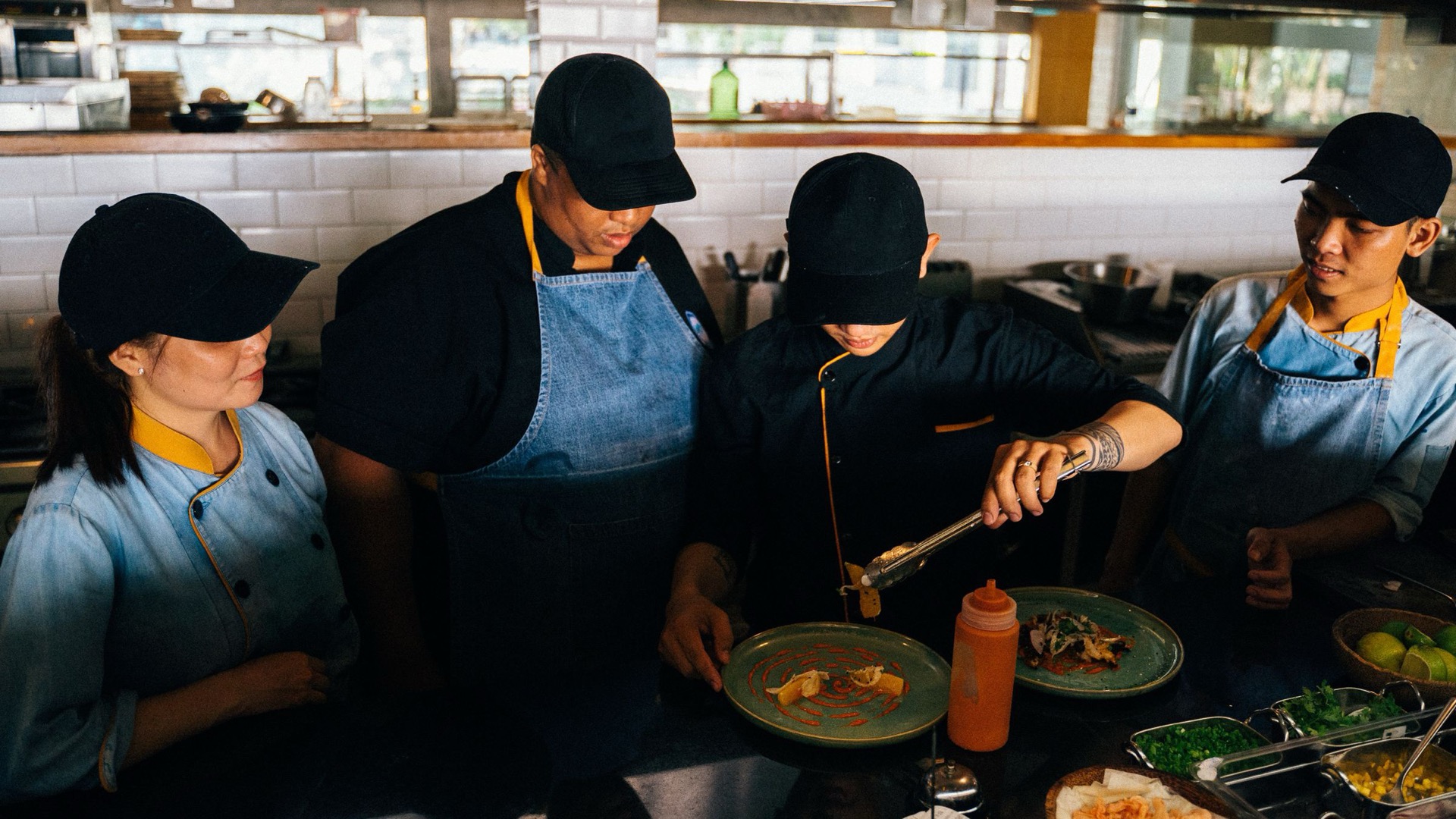
Photo by Anna Tarazevich on Pexels
Most restaurants train the same way: a new hire follows whoever is working that night, picks up what they can, and gets put on the schedule when someone decides they look ready. Two servers hired the same week end up trained two different ways, by two different people, to two different standards.
A restaurant training program fixes that. It is a written plan for each position that spells out what a new hire learns, in what order, from whom, and how you know they actually learned it. This guide walks through how to build one: how to structure it by position, what goes in each module, a day-by-day plan for servers and line cooks, the quizzes and sign-offs that prove someone is trained, and who should own it. At the end there is a free training program template you can save as a PDF.
What a Restaurant Training Program Is (and Isn't)
A training program is the curriculum. It is not the same thing as the documents around it, and mixing them up is why so many programs stall out.
- Onboarding is the first week of getting someone into the building: paperwork, uniform, tour, introductions. Our guide to the restaurant onboarding process covers that week.
- The handbook is your policies and conduct. See our employee handbook checklist.
- SOPs are the written way each task gets done. The training program teaches them, but it doesn't replace them. Here's how to write restaurant SOPs.
The training program ties those pieces together into a path: this position learns these modules, in this order, and finishes with a sign-off. If you have SOPs but no program, you have a library nobody reads. If you have a program but no SOPs, your trainers teach whatever they remember.
Structure It by Position, Not by Topic
The most common mistake is building one big training binder for everyone. A dishwasher doesn't need wine notes and a host doesn't need station setup. Build a short list of shared modules everyone takes, then a track for each position on top of it.
| Position | Shared modules | Position track |
|---|---|---|
| Server | House standards, menu basics, food safety habits, opening and closing culture | Full menu and modifiers, steps of service, POS, section side work, upselling |
| Bartender | Same as above | Drink specs, bar setup and breakdown, pour standards, bar side work |
| Host | Same as above | Floor plan and rotation, reservations and waitlist, phone, greeting standard |
| Line cook | Same as above | Station setup, recipes and plating, prep list, ticket times, station breakdown |
| Prep cook | Same as above | Recipes and yields, prep list, labeling and storage, ordering of tasks |
| Dishwasher | Same as above | Dish machine, chemical setup, flow of dirty and clean, closing the dish pit |
Once a position track exists, cross-training becomes easy. A server who wants bar shifts takes the bar track. Nobody has to invent a plan on the spot.
What Goes in Each Training Module
A module is one topic a new hire can learn, practice, and be checked on. Keep each one small enough to finish in a shift or two. These are the modules that do the most work in most restaurants.
Menu knowledge
Every dish: what is in it, how it is cooked, how it is plated, what it pairs with, and the common modifiers. Allergens and ingredients get their own section, because that is where a wrong answer hurts a guest. FOH learns to describe and sell it. BOH learns to make it.
Steps of service
The sequence from greet to goodbye, with the timing you expect between each step: greet, drinks, order, check-back, pre-bus, dessert, check, farewell. Write it the way your restaurant actually does it, including the small things that make your service yours.
Station setup
For BOH, a photo of each station fully set, the par for every item, and where everything lives. For FOH, side work and section setup. A mise en place standard turns this from a habit into something you can check.
Recipes and plating
Every recipe the cook will touch, with quantities, method, and a plating photo. If recipes live in your chef's head, write them down first with a recipe sheet template. You can't train to a standard that doesn't exist on paper.
Opening and closing duties
The checklists for each position, taught by doing them next to someone who already does them well. Closing is where most new hires get lost, so give it its own day in the plan.
Food safety and sanitation
Include it as a module for every position: handwashing, glove use, labeling and dating, storage, cleaning routines, and how your kitchen logs temperatures. Teach your house procedures, and confirm the specific requirements for your staff, including any certifications, with your local health department.
A Day-by-Day Training Plan for Servers and Line Cooks
Here is a 10-shift plan for the two positions most restaurants hire most often. Each day ends with a check, so you know whether the trainee is on pace before they're alone on a Friday.
| Shift | Server | Line cook | Check at end of shift |
|---|---|---|---|
| 1 | Tour, house standards, menu module part 1 | Tour, station map, equipment walk-through | Menu or station quiz |
| 2 | Shadow a trainer for a full shift | Shadow on the trainer's station | Trainer notes |
| 3 | Menu part 2: allergens, modifiers, drinks; POS practice | Station prep from the recipe cards | Allergen quiz / prep check |
| 4 | Steps of service; takes 2 tables with trainer watching | Works the station on a slow service, trainer beside them | Trainer checklist |
| 5 | Opening side work; reverse shadow (trainee leads) | Opening line check; reverse shadow | Opening checklist complete |
| 6 | Small section, trainer floating | Station solo on a slow shift, trainer nearby | Ticket times, guest feedback |
| 7 | Closing duties with trainer | Station breakdown and closing | Closing checklist complete |
| 8 | Normal section, mid-volume shift | Normal station, mid-volume shift | Trainer notes |
| 9 | Full section on a busy shift | Full station on a busy shift | Manager observes |
| 10 | Final menu quiz and sign-off conversation | Cooks each station dish to spec for the chef | Sign-off by name |
The key move is the reverse shadow on shift 5. Watching someone work feels like learning. Doing the work while the trainer watches is the only way to find out whether it stuck.
Your training program, on every new hire's phone.
The whole operation in one place, built around the way your restaurant already works. Money stops leaking, your time stops disappearing into follow-up, and every shift leaves a record with a name on it.
Prove It: Quizzes and Sign-Offs
"They've been here two weeks" is not the same as "they're trained." Every module should end with proof, and the proof should be written down with a name and a date.
Trained
- Passed the menu and allergen quiz, score saved
- Did the closing checklist alone, trainer checked it
- Cooked every station dish to spec for the chef
- Signed off by name, with a date
Just exposed to it
- Read the menu once
- Watched someone close a few times
- "Seems fine on the line"
- Put on the schedule because you were short
Keep quizzes short: 10 to 15 questions per module, written the way guests and tickets actually ask. "A guest at table 12 can't have dairy. Which three dishes can you recommend?" tells you more than "List the ingredients in the risotto." Set a passing score, let people retake it, and keep the result.
The sign-off is the trainer and the manager agreeing, in writing, that this person can do this job alone. It also tells you exactly who trained whom, which matters the first time something goes wrong.
Who Owns Training
Training fails when it belongs to everyone. Give it clear owners:
- Program owner (GM or owner): keeps the program written, current, and used. Signs off the final step for every hire.
- Department leads (chef, kitchen manager, FOH manager): own the modules and quizzes for their side of the house.
- Trainers: one or two of your best people per position, chosen because they do the job the right way, not just the fastest way. Give them the plan, the checklists, and some recognition for doing it.
Your managers need their own version of this. Our guide to training restaurant managers lays out a phased plan for that role.
How to Keep the Program Current
A training program goes stale the first time the menu changes and nobody updates the quiz. Tie updates to the moments that make content wrong:
- Menu change: update the menu module, recipes, and quiz the same week.
- Repeated mistake: if the same error shows up twice, it is a training gap. Add it to the module. (This is the pattern we dig into in why restaurant teams keep making the same mistakes.)
- New equipment or process: new module, and retrain the current team, not just new hires.
- Quarterly review: read each track start to finish and cut anything nobody does anymore.
This is where paper binders break down. A restaurant training app keeps one current version on every phone, so an update reaches the whole team at once. Generic restaurant training software can host modules, but it is built for every restaurant at once. Your menu, your steps of service, and your closing list are what new hires need to learn. A restaurant employee app built around your operation puts training, recipes, and the handbook in the same place your team already checks every shift.
It also pays off in retention. Turnover is high across the industry (the National Restaurant Association's research tracks workforce trends closely), and the Bureau of Labor Statistics notes that most waiters and waitresses learn through short-term on-the-job training. That on-the-job training is your program, whether you wrote it down or not. People stay longer where they feel set up to succeed, which we cover in our guide to restaurant staff turnover.
The Free Restaurant Training Program Template
Use this checklist to build your program, then run it for each new hire. Tick the boxes as you go, or hit Save as PDF to print a copy for each trainee's file.
Restaurant Training Program Checklist
Build the program (once per position)
Before the first shift
Modules (date + trainer initials)
Proof
Trainer sign-off: Date:
Manager sign-off: Date:
A starting template, not a compliance document. Confirm food safety and any certification requirements for your staff with your local health department.
If you want every new hire trained the same way, with modules, quizzes that save scores, and sign-offs by name in an app built around your restaurant, let's talk.
Frequently Asked Questions
What should a restaurant training program include?
A restaurant training program should include shared modules every employee takes, such as house standards, menu basics, food safety habits, and opening and closing culture, plus a track for each position. Each module covers one topic, ends with a quiz or practical check, and gets signed off by a named trainer. Add a day-by-day plan so every new hire follows the same order, and name who owns the program and keeps it current.
How long should restaurant training take?
For servers and line cooks, around 10 shifts is a practical starting point: a few days of shadowing, a reverse shadow where the trainee leads, then solo shifts at increasing volume. Experienced hires can move faster and fine dining or complex menus may take longer. The better measure is not days but proof. Someone is trained when they have passed each module's check and been signed off, not when a set number of days has gone by.
What is the difference between onboarding and training?
Onboarding is getting someone into the building: paperwork, uniform, tour, introductions, and policies, usually in the first few days. Training is teaching them to do the job to your standard, module by module, and proving they can. Onboarding happens once. Training continues through the first few weeks and comes back every time the menu, the equipment, or the process changes.
Who should train new restaurant employees?
Pick one or two trainers per position who do the job the right way, not just the fastest way. They run the shadow shifts, watch the reverse shadow, and sign off modules. Department leads like the chef or FOH manager own the content and quizzes for their side of the house, and the GM or owner owns the program as a whole and signs off the final step for every hire.
How do you know if a restaurant employee is fully trained?
Use proof, not time. A fully trained employee has passed the quiz for every module with the score recorded, completed opening and closing alone with a trainer checking the work, worked a full shift at normal volume while a manager observed, and been signed off by name and date. If any of those are missing, they have been exposed to the job but not trained on it.
Do I need a restaurant training app or software?
You can run a training program on paper, and many restaurants do. The problem is keeping it current and knowing who finished what. A restaurant training app puts the modules, quizzes, and sign-offs on every employee's phone, so a menu change reaches everyone at once and quiz scores are saved automatically. The best fit is one built around your own menu and procedures, not generic course content.