
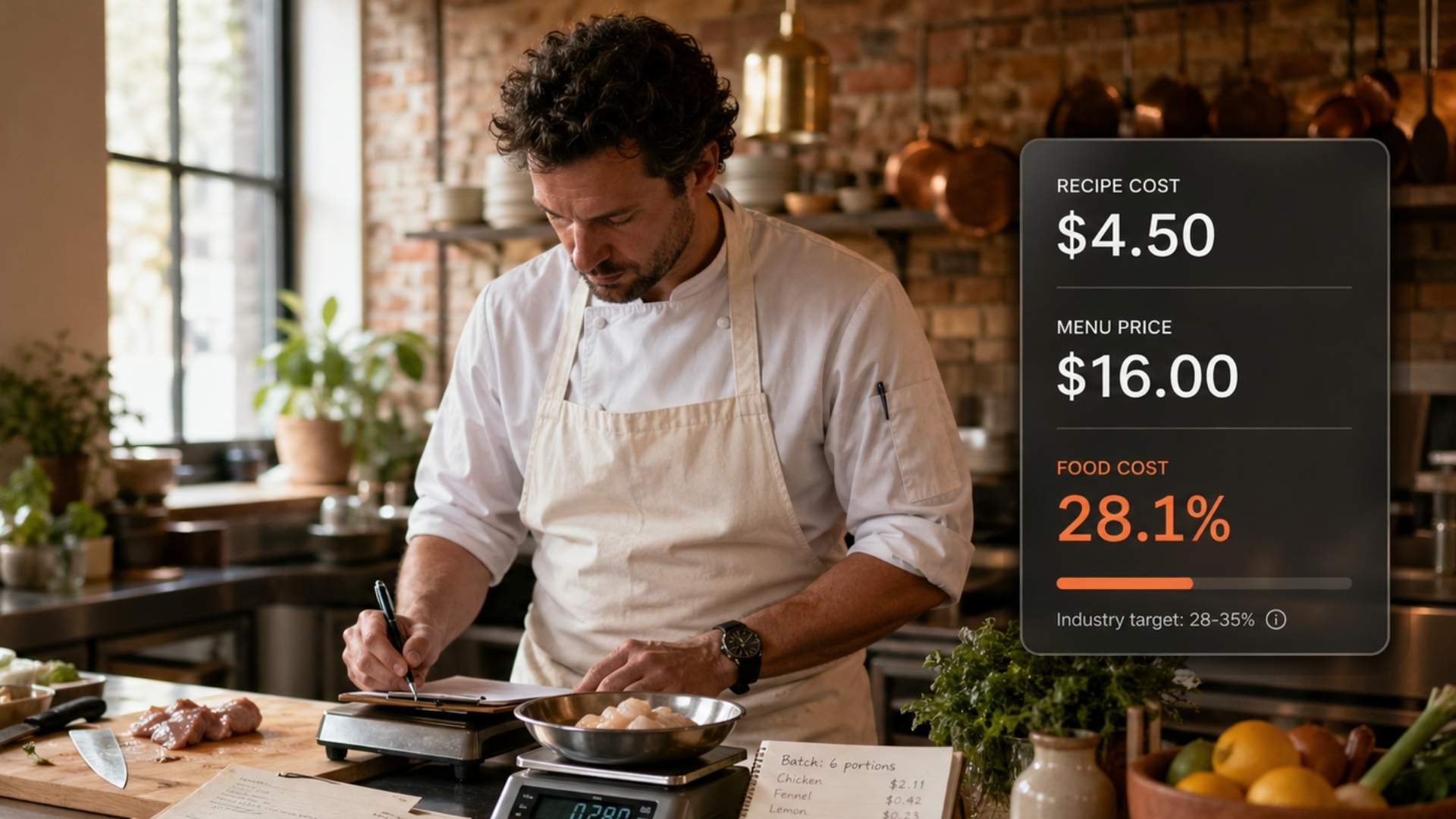
Food cost is the difference between a restaurant that runs profitably and one that quietly bleeds margin every shift. Most operators know the number matters. Far fewer know exactly what their food cost percentage is on each dish — and even fewer recalculate when supplier prices shift, which they do constantly.
This page gives you a free restaurant food cost calculator, the formula for calculating your food cost percentage, benchmarks for the ideal food cost by restaurant type, and a downloadable spreadsheet template for tracking your whole menu. Use it now and recalculate every quarter.
Free Restaurant Food Cost Calculator
Plug in your numbers below. The calculator works two ways — find your food cost percentage on an existing dish, or work backwards from a target food cost percentage to find the menu price you should be charging.
How to Calculate Food Cost Percentage (Formula + Example)
The math is simple. The discipline of running it consistently is what separates restaurants that hit their margins from ones that don't. Note that a period food cost also needs opening and closing counts, which is covered in our guide to restaurant inventory management.
Food Cost % = (Cost of Ingredients ÷ Menu Price) × 100
If your burger costs $4.50 in ingredients and you sell it for $16.00, your food cost percentage is 28.1%. If your supplier raises the price of beef and your ingredient cost climbs to $5.50 without a menu price change, your food cost jumps to 34.4% — and you've quietly lost more than 6 points of margin on every burger you sell.
There are two ways to think about the food cost percentage formula, and both matter. The per-dish version (above) tells you whether a specific menu item is priced correctly. The blended version — total food cost divided by total food sales — tells you how the whole operation is performing. Most operators check the blended number monthly off their P&L, then only investigate per-dish food cost when something looks off. That's backwards. The per-dish food cost percentage is where the leaks start. By the time the blended number moves, you've already lost months of margin.
Run the per-dish calculation any time a recipe is created, a supplier price changes by more than 5%, or a menu item is repriced. Run the blended calculation monthly off your invoices and POS sales report. The gap between the two — what your menu is theoretically yielding versus what's actually hitting the books — is usually waste, theft, portion drift, or comp meals you forgot to track.
The numbers get logged whether you’re there or not.
The whole operation in one place, built around the way your restaurant already works. Money stops leaking, your time stops disappearing into follow-up, and every shift leaves a record with a name on it.
What Is the Ideal Food Cost Percentage by Restaurant Type?
There's no single ideal food cost percentage that applies to every restaurant. The right target depends on your concept, your ingredient quality, and your service model. The widely accepted range across the industry is between 28% and 35%, but that range hides a lot of variation. Here's what the ideal food cost looks like broken down by restaurant type:
- Quick-service / fast food: 25-30%. Lower ingredient quality and high volume make tight food cost achievable.
- Fast casual: 28-32%. Higher-quality ingredients than QSR but still volume-driven.
- Casual dining (full service): 28-33%. The most common operator profile and the most common food cost target.
- Upscale casual / chef-driven: 30-35%. Better ingredients, smaller batches, more chef discretion on the line.
- Fine dining / steakhouse: 35-40%. Premium proteins and high-end produce push ingredient cost up. Higher menu prices and average ticket compensate.
- Pizzerias: 25-30%. Dough is cheap and forgiving, but cheese and protein costs swing food cost fast.
- Bars (beverage): 18-24% on liquor, 22-28% on beer, 28-35% on wine. Cocktail programs sit lower; wine-heavy programs sit higher.
- Bakeries / cafés: 30-35%. Flour, butter, and dairy volatility makes this category harder to keep tight.
Here's how to read where you fall once you've calculated yours:
- Under 28% — You have margin, but check that portions and quality aren't slipping. Sometimes a "great" food cost percentage is really cooks skimping on plates.
- 28-32% — The sweet spot for most full-service restaurants.
- 32-35% — Watch closely. A small ingredient price hike can push you into the danger zone.
- Over 35% — You are likely losing money on this dish, or your concept depends on volume and beverage attach to compensate.
The ideal food cost for your restaurant is not the lowest number you can hit. It's the number that protects your margin without compromising the plate. Cutting food cost by switching to a cheaper protein might save 2 points on paper and lose 10% of repeat customers — that's a worse trade than running 33% on the original recipe.
For data on how prices are shifting industry-wide, the National Restaurant Association tracks industry food cost benchmarks updated regularly. The USDA also publishes the USDA Food Price Outlook, which is worth checking quarterly to see where supplier pricing is headed.
How to Calculate Food Cost on a Recipe
The calculator above works for one dish at a time. To get there, you need to actually cost out the recipe — which means you need a current, documented recipe to cost. The full discipline of how to do this properly, including the small ingredients and yield adjustments most operators miss, is in our breakdown of why recipe costing is the habit profitable kitchens never skip. If your recipes still live in someone's head, start with our guide on restaurant standard operating procedures, then come back here to do the math. The process is the same every time:
- List every ingredient in the recipe, including the small ones (sauces, garnishes, oil, salt).
- Get the unit price from your most recent invoice. Not the price you remember — the price on this week's invoice.
- Calculate the per-portion cost for each ingredient. If a 5 lb bag of flour costs $12 and a recipe uses 8 oz, that's $1.20 per portion.
- Sum the ingredient costs for one portion. That's your recipe cost.
- Plug it into the calculator with the menu price to get your food cost percentage.
This is also exactly the process that breaks down the most when staff turnover is high. Recipes drift. Yields change. Prep amounts get fudged. The result is your real food cost diverges from your spec, and you do not know it until the P&L comes in.
"Your food cost is only as accurate as the recipe being followed. If recipes live in someone's head, your food cost is a guess."
How to Lower Your Restaurant Food Cost
If your calculator results show a food cost above 32%, there are a handful of levers worth pulling before you reach for the menu price increase that nobody wants.
- Tighten portion control — Inconsistent portions are the single biggest hidden food cost driver. A few extra ounces per plate compound across thousands of covers.
- Renegotiate with suppliers quarterly — Pricing is not fixed. If you have not had a pricing conversation with your main supplier in six months, you are leaving money on the table.
- Audit your spec sheet — Are cooks actually following the recipe, or has the dish quietly evolved? Pull a plated dish off the line and weigh it.
- Cut the bottom 20% of menu items — Your worst-performing dishes are usually the ones with the highest food cost AND the lowest sales. Removing them improves your blended food cost percentage.
- Track waste — Spoilage, overproduction, and "let's just eat it" all show up in your food cost without an invoice attached. Make staff log it. The full playbook for cutting it is in our guide on restaurant food waste.
- Reprice with a real framework — Cost × 3 isn't a pricing strategy. The full four-lens approach to setting menu prices that protect margin without scaring guests is in our breakdown of the menu pricing formula most restaurants get wrong.
This is the kind of work that compounds. The post on the real cost of running without a system covers the wider financial picture — food cost is one piece of it, but disorganized operations cost you in dozens of small ways every shift.
Common Food Cost Mistakes
A few patterns that quietly destroy margin:
- Using last quarter's ingredient prices — Recalculate when supplier costs change. Not when the P&L shocks you.
- Forgetting the small ingredients — Oil, sauces, salt, garnishes, and packaging add up. A recipe that "costs $3" probably actually costs $3.40 once you include them.
- Ignoring yield loss — If you buy 10 lbs of beef and 1.5 lbs is trim, your real cost per usable pound is higher than the invoice suggests.
- Pricing based on what competitors charge — Your costs are not their costs. Price for your numbers, not theirs.
- Not having a single source of truth — When recipes live in three different places (manager's head, a binder, a Google Doc), your food cost is unmeasurable.
Where Food Cost Tracking Actually Lives
The hardest part of food cost is not the math. It is keeping recipes, costs, and updates synchronized across your team. When the head chef knows the spec but the line cooks are using a different version, your food cost calculation is fiction.
The best operators we work with handle this by centralizing recipes and costs in one place — accessible from every team member's phone, updated whenever a supplier price shifts or a recipe gets refined. A digital recipe book built into a custom operations app is what makes this practical at scale. And when it's time to build out a whole new menu or refresh an existing one, the full process — from concept through launch — is covered in our breakdown of what restaurant menu development actually looks like behind the scenes.
If you are figuring out how to bring this kind of structure into your operation broadly, the framework in how to organize restaurant operations walks through it step by step. And for the daily checks that keep food cost from drifting, our complete daily operations checklist includes the line check items that catch portion drift before it shows up on the P&L. Cost control is one of six pillars — for the complete framework, see our complete guide to restaurant operations.
Track Your Whole Menu
The calculator above works one dish at a time. For tracking your entire menu, your supplier price changes, and your blended food cost percentage, use the spreadsheet template. Add your dishes, plug in costs, and see your food cost across the whole operation in seconds.
If you want to stop tracking food costs across scattered binders and spreadsheets, Crewli builds a fully custom operations app that holds your recipes, prep specs, and costs together — updated instantly when prices shift, accessible to every team member. Let's talk.
Frequently Asked Questions
What is a good food cost percentage for a restaurant?
Most full-service restaurants target a food cost between 28% and 32%. Casual concepts run lower (25-30%), fine dining and steakhouses run higher (35-40%) due to premium ingredients, and bars typically run 18-24% on beverages. Anything over 35% means you are likely losing money on that dish or relying on volume to compensate.
How do you calculate food cost percentage?
Divide the cost of ingredients by the menu price, then multiply by 100. The formula is: Food Cost % = (Cost of Ingredients ÷ Menu Price) × 100. For example, a burger with $4.50 in ingredients sold for $16.00 has a food cost of 28.1%.
How do you lower food cost in a restaurant?
The highest-leverage moves are tightening portion control, renegotiating supplier pricing quarterly, auditing your spec sheets to confirm cooks are following recipes, cutting the bottom 20% of underperforming menu items, and tracking waste as a line item. Menu price increases should be the last lever, not the first.
How often should I recalculate food cost?
Recalculate every quarter at minimum, and any time a major supplier price changes. Food cost drifts constantly because ingredient costs, yields, and portions shift over time. Operators who only check food cost once a year are typically off by several percentage points without realizing it.
What is the difference between food cost and prime cost?
Food cost only includes the cost of ingredients used to make the dish. Prime cost includes food cost plus labor cost. Most operators target a prime cost of 60-65% of total revenue. Food cost is the more granular per-dish metric, while prime cost is the broader measure of operational efficiency. For the labor half of the prime cost equation, see our guide on restaurant labor cost.
Should I include packaging and small ingredients in food cost?
Yes. Oil, salt, sauces, garnishes, and packaging add up across thousands of plates. A recipe that appears to cost $3 in main ingredients often actually costs $3.40 once you include the small items. Skipping these is one of the most common reasons operators underestimate their real food cost.